
Telecom Power System Market Trends Driving Growth to USD 11.91 Billion by 2035
Telecom Power System Market Size, Share and Research Report By Component (Rectifiers, Converters, Controllers &
Press Release Disclaimer: This is a press release distributed through the XPR Media network. It has not been independently verified by our newsroom.
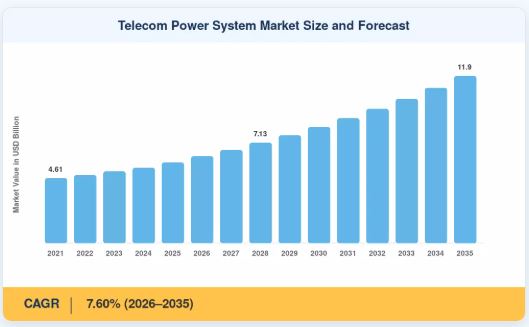

Telecom Power System Market Size, Share and Research Report By Component (Rectifiers, Converters, Controllers & Monitoring, Fuel Cells),
NEW YORK,, NY, UNITED STATES, August 13, 2026 /EINPresswire.com/ — The Global Telecom Power System market reached a valuation of USD 5.72 billion in 2025, driven by an unprecedented cycle of network densification and energy-efficiency mandates reshaping operator capital expenditure. Starting from USD 6.16 billion in 2026, the market is projected to climb to USD 11.91 billion by 2035, registering a CAGR of 7.60% across the forecast period.
The rollout of 5G standalone architectures each macro site drawing roughly double the power of its 4G predecessor has forced operators worldwide to rethink their power infrastructure from the ground up. The market’s 7.60% CAGR reflects the convergence of 5G NR densification and macro site power uplift (25–30% impact), rural electrification and off-grid expansion (15–20%), lithium-ion battery migration (12–15%), and edge computing and micro data center build-outs (10–14%) accelerating across the world’s largest mobile-subscriber and network-infrastructure economies simultaneously.
The telecom power system market is under a marked technological transformation. Traditional valve-regulated lead-acid battery banks and individual diesel generators are gradually being replaced by lithium-ion energy storage and hybrid solar-diesel systems. The GSMA estimates that the mobile industry consumed approximately 250 TWh of electricity in 2024, representing about 0.6% of global electricity use, and operators have collectively committed to halve absolute emissions by 2030.
These commitments are already translating into procurement changes, with higher-efficiency rectifiers, modular DC power plants, and intelligent energy-management controllers now standard line items for new site builds and legacy site retrofits alike. Asia-Pacific commands 37.6% market share owing to large rural connection initiatives in India and quick implementation of the 5G roadmap in China, South Korea, and Japan, and the region also witnesses the fastest development trajectory with a CAGR of 8.90% through 2035. North America accounts for approximately 24.8% of 2025 revenue, with investment in grid-resilience and climate-hardened power solutions growing as extreme weather events become more frequent.
Get Full PDF Sample Copy of Report: (Including Full TOC, List of Tables & Figures, Chart) @
https://www.marketresearchfuture.com/sample_request/2378
➤ How Significant Is the Telecom Power System Market’s Growth?
The telecom power system market’s trajectory from USD 5.72 billion in 2025 to a projected USD 11.91 billion by 2035 represents more than a two-fold expansion over the forecast decade, reflecting the structural shift from VRLA-and-diesel legacy power architectures toward lithium-ion, hybrid renewable, and intelligently managed site power platforms. The market’s 7.60% CAGR is anchored in a densification-and-decarbonization supercycle where 5G power-demand escalation, rural electrification mandates, and ESG-driven emission-reduction commitments are all converging to make power infrastructure a strategic capital-allocation priority for every major telecom operator.
Rectifiers accounted for 25.7% of the market in 2025, reflecting the critical role of AC-to-DC conversion in every macro and small-cell deployment, while lithium-ion energy storage is positioned to expand at a 14.7% CAGR through 2035 as operators migrate away from VRLA platforms for lower lifecycle cost and higher energy density; DC power plants held USD 3.20 billion in revenue during 2025, underscoring operator preference for simplified, high-efficiency architectures. By network generation, 4G/LTE networks retained 52.3% of market revenue in 2025, though that share will erode as 5G NR deployments accelerate at a 15.8% CAGR. By power source, grid-connected solutions captured the largest share in 2025 at 50.8%, while hybrid solar-diesel configurations are gaining ground at a 12.7% CAGR.
➤ What Does the Future Hold for the Telecom Power System Market?
5G NR densification and macro site power uplift contribute approximately 25–30% of driver impact to the telecom power system market’s growth the single highest driver impact. A single 5G massive-MIMO radio device can consume 3–4 kW at peak load, approximately twice the consumption of a 4G panel of similar capacity. GSMA Intelligence expects that by 2028, the number of 5G base stations worldwide will exceed 15 million, and as a result operators are purchasing higher-capacity rectifiers, larger battery reserves, and more powerful cooling systems at each macro and small-cell site simultaneously.
Rural electrification and off-grid expansion contribute approximately 15–20% of driver impact, establishing connectivity mandates as a primary structural demand source. India’s BharatNet Phase III program seeks to provide fiber and wireless broadband to over 640,000 villages, many of which do not have stable grid energy, while similar initiatives in Sub-Saharan Africa, including the World Bank’s Digital Economy for Africa program, are fueling demand for self-contained solar-hybrid and fuel-cell power plants designed for isolated telecom sites.
Lithium-ion battery migration adds a further 12–15% of impact as BloombergNEF data indicates lithium-ion pack prices fell below USD 130 per kWh in 2024, narrowing the upfront cost gap against VRLA to less than 20% while delivering 40–50% lower total cost of ownership over the system lifetime, and edge computing and micro data center build-outs contribute a further 10–14% as operators deploy multi-access edge computing nodes at cell-site aggregation points, adding 5–15 kW of IT load to locations originally dimensioned for radio equipment only.
The next phase of the market’s evolution centers on AI-optimized autonomous power management, with most Tier-1 operators expected to deploy AI-based site energy controllers by 2030 capable of dynamically balancing grid draw, battery discharge, solar harvest, and generator run-time without human intervention pilot programs by Vodafone and Telefónica have already demonstrated 18–22% energy-cost reduction using reinforcement-learning algorithms.
The IEA projects global electricity demand to grow by 75% between 2024 and 2040, creating grid-capacity constraints that will push telecom operators toward on-site generation, storage, and demand-response participation, with operators managing large tower portfolios increasingly functioning as distributed energy resources selling stored energy back to utilities during peak demand. Standardized, factory-assembled power containers integrating rectifiers, batteries, solar charge controllers, and thermal management in a single ISO-format enclosure are also reducing site deployment time from weeks to days, aligning with the market’s shift toward rapid, repeatable edge-site builds.
Get access to the full description of the report @
https://www.marketresearchfuture.com/reports/telecom-power-system-market-2378
➤ Who Are the Key Players in the Telecom Power System Market?
The telecom power system market exhibits medium concentration, with the top five vendors commanding an estimated 45–55% of global revenue. The competitive field spans vertically integrated power-electronics conglomerates, telecom-specialist OEMs, and battery and fuel-cell pure plays, with strategic differentiation increasingly hinging on software-defined energy management, lifecycle-service contracts, and the ability to deliver pre-integrated, containerized solutions that compress deployment timelines. The estimated Herfindahl-Hirschman Index falls in the 800–1,200 range, consistent with a moderately competitive structure. MRFR identifies the following key participants with estimated revenue share ranges:
★ Vertiv (~12–15% share) – the broadest integrated portfolio leader for indoor and outdoor sites providing NetSure rectifiers, Liebert thermal management, and SmartCabinet enclosures, anchoring much of the industry’s mission-critical telecom power infrastructure.
★ Huawei Digital Power (~10–13% share) – a scale-advantaged provider across Asia-Pacific and emerging markets offering iSitePower, SmartLi batteries, and blade power supplies, leveraging deep integration with Huawei’s broader radio and network equipment portfolio.
★ Delta Electronics (~8–11% share) – a hybrid and solar-integrated architecture specialist providing InfraSuite, Eltek rectifier modules, and outdoor cabinets, having launched a compact SMART PDU I-Type power distribution unit for telecom and data center operators.
★ Eaton (~6–9% share) – a North America and Europe enterprise-grade focus provider offering DC power systems, lithium UPS, and grid-interactive inverters, positioned across climate-hardened and edge-computing power deployments.
★ ZTE (~5–8% share) – a vertically integrated radio-plus-power bundle specialist providing UniSite, modular DC power, and solar-hybrid kits, serving operators seeking combined network-equipment and power-infrastructure procurement.
★ Schneider Electric (~4–7% share) – a software-defined energy management differentiator offering Galaxy UPS, EcoStruxure IT, and modular data centers, positioning converged telecom-and-edge power platforms as a core growth vector.
★ Cummins (~3–6% share) – the generator-dominant incumbent expanding into hydrogen fuel cells, providing diesel and gas generators, fuel-cell backup, and PowerCommand controls, serving grid-unstable and off-grid site deployments.
★ ABB (~3–5% share) – a utility-grade power conversion specialist for large sites offering rectifiers, switchgear, and grid-edge inverters, serving operators requiring industrial-scale power conversion at aggregation and hub sites.
★ EnerSys (~2–4% share) – a battery-specialist positioned across all chemistries offering telecom batteries in both VRLA and lithium-ion formats alongside Purcell systems, serving as a core supplier across the VRLA-to-lithium transition.
★ Emerson Electric (~2–4% share) – a legacy installed-base and retrofit services provider offering outdoor power shelters and DC conversion modules, serving operators upgrading brownfield sites with minimal architectural disruption.
Strategic competition in the telecom power system market is increasingly defined by software-defined energy management and containerized deployment speed with grid instability and volatile energy costs cited as a top constraint in emerging markets, as diesel generators account for up to 30% of network operating expenditure in markets like Nigeria, Pakistan, and Bangladesh where grid availability at tower sites can fall below 8 hours per day, alongside semiconductor supply-chain bottlenecks that extended lead times for custom telecom power modules to 26–40 weeks during 2022–2023, high upfront capital requirements for renewable-hybrid systems, and regulatory fragmentation in permitting across Europe and Latin America.
➤ What Are the Emerging Trends in the Telecom Power System Market?
Several transformational trends are redefining the telecom power system market’s evolution through 2035:
5G NR Densification and Power Demand Escalation: GSMA Intelligence expects 5G base stations worldwide to exceed 15 million by 2028, with each massive-MIMO radio consuming 3–4 kW at peak load approximately double a comparable 4G panel driving demand for higher-capacity rectifiers, larger battery reserves, and more powerful cooling systems at every site.
Rural Connectivity and Off-Grid Deployments: India’s BharatNet Phase III program targets fiber and wireless broadband for over 640,000 villages lacking stable grid energy, while World Bank-backed initiatives across Sub-Saharan Africa are fueling demand for self-contained solar-hybrid and fuel-cell power plants at isolated telecom sites.
Lithium-Ion Battery Transition: Lithium-ion pack prices fell below USD 130 per kWh in 2024, narrowing the upfront cost gap against VRLA to less than 20% while delivering 40–50% lower total cost of ownership over an 8–10 year service life compared to VRLA’s 3–5 years, decisively shifting new-site procurement.
Hydrogen Fuel Cells for Zero-Emission Backup: Several European operators are piloting 5–10 kW proton-exchange membrane fuel cells as diesel alternatives at emission-sensitive urban sites, with the European Clean Hydrogen Alliance targeting 6 GW of electrolyzer capacity by 2030 to lower hydrogen costs toward commercial routine deployment.
Energy-as-a-Service Models for Tower Companies: Independent tower companies, controlling over 60% of global tower inventory, are increasingly bundling power procurement and management as a subscription-based service, shifting risk from mobile operators to towercos and opening the market to infrastructure-grade financial investors.
Buy Full Research Report:
https://www.marketresearchfuture.com/checkout?currency=one_user-USD&report_id=2378
➤ How Is the Telecom Power System Market Segmented?
The telecom power system market report provides a comprehensive segmentation framework:
By Component: Rectifiers (25.7% share, 2025), Converters (USD 0.92 billion, 2025), Controllers & Monitoring (8.80% CAGR), Fuel Cells (13.7% CAGR)
By Power Source: Grid-Connected (50.8% share, 2025), Diesel Generator (USD 0.97 billion, 2025), Hybrid Solar-Diesel (12.7% CAGR), Hybrid Solar-Battery (13.2% CAGR)
By Energy Storage Technology: VRLA Battery (58.6% share, 2025), Lithium-Ion (14.7% CAGR), Supercapacitors (9.20% CAGR)
By Network Generation: 4G/LTE (52.3% share, 2025), 5G NR (15.8% CAGR), Legacy 2G/3G (USD 0.31 billion, 2025)
By System Architecture: DC Power Systems (55.9% share, 2025), AC Power Systems (USD 1.18 billion, 2025), Hybrid AC/DC (11.8% CAGR)
By Region: Asia-Pacific (37.6%), North America (USD 1.42 billion, 2025), Europe (7.80% CAGR), South America (USD 0.49 billion, 2025), Middle East & Africa (8.40% CAGR)
➤ What Are the Regional Insights from the Telecom Power System Market?
Asia-Pacific dominates the telecom power system market at 37.6% share in 2025, generating USD 2.15 billion in revenue, reflecting the scale of India’s BharatNet program and China’s tower-sharing expansion. China commands 42.3% of regional share as China Tower Corporation alone manages over 2.1 million tower sites and is systematically upgrading power systems to support dual 4G/5G loads.
India is posting a 9.50% CAGR within the region through BharatNet Phase III and 5G SA spectrum awards, with Indian towercos deploying solar-hybrid solutions at over 50,000 sites per year to reduce diesel consumption. Japan contributed USD 0.22 billion through NTT and KDDI green-network commitments, South Korea is growing at a 7.80% CAGR through dense urban 5G mmWave small-cell power requirements, and ASEAN is growing at an 8.60% CAGR through tower-company expansion and rural 4G infill.
North America accounts for approximately 24.8% of 2025 revenue and is projected to reach a 7.30% CAGR through 2035, driven by wildfire-resilience retrofits and edge-site proliferation. The United States commands 68.5% of regional share as operators invest in climate-hardened sites following the 2023–2024 wildfire and hurricane seasons that exposed grid-dependency risks, with the FCC’s 72-hour backup-power mandate for cell sites remaining a key procurement driver and Tier-1 operators piloting 48V lithium-iron-phosphate batteries at scale. Canada is growing at a 7.20% CAGR through northern connectivity programs and First Nations broadband, and Mexico contributed USD 0.11 billion through shared-network expansion under the IFT regulatory framework.
Europe is projected to register a 7.80% CAGR through 2035, with European operators facing binding carbon-reduction targets under the European Green Deal and several national regulators linking spectrum-renewal conditions to energy-efficiency commitments. Germany commands 22.8% of regional share through Energiewende-aligned renewable telecom power mandates, the UK is growing at a 7.90% CAGR through the Shared Rural Network and Open RAN power requirements, France contributed USD 0.14 billion through ARCEP energy-efficiency targets, Italy is posting a 6.80% CAGR through 5G densification in urban corridors, Spain contributed USD 0.09 billion through solar-hybrid adoption in southern tower portfolios, and the Nordic countries are growing at a 7.40% CAGR through arctic-hardened power solutions for remote sites.
South America and the Middle East & Africa round out the telecom power system market’s regional footprint, with the latter posting an 8.40% CAGR through 2035. Brazil commands 58.2% of South American revenue as Anatel’s 3.5 GHz auction conditions require operators to extend coverage to underserved municipalities by 2028, with towercos such as American Tower and SBA Communications investing in solar-hybrid power plants at rural sites where grid availability averages 12–16 hours per day, while Argentina is growing at a 7.10% CAGR through rural connectivity expansion under ENACOM programs.
In the Middle East & Africa, Saudi Arabia commands 28.4% of regional share through NEOM and Vision 2030 telecom infrastructure, the UAE is growing at a 7.60% CAGR through smart-city 5G deployments and sustainability mandates, South Africa contributed USD 0.06 billion through load-shedding mitigation and tower backup upgrades with MTN and Vodacom investing over USD 200 million in battery and generator upgrades since 2022, and Egypt is growing at an 8.10% CAGR through population growth and 4G densification.
➤➤➤ Regional & Country-Level Reports by Market Research Future:
US Telecom Power System Market –
https://www.marketresearchfuture.com/reports/us-telecom-power-system-market-16792
➤➤➤ Industry Analysis Reports by Market Research Future:
Consulting, Legal, And Management Services Market
https://www.marketresearchfuture.com/reports/consulting-legal-and-management-services-market-66316
Consumer Insights And Market Intelligence Services Market
https://www.marketresearchfuture.com/reports/consumer-insights-and-market-intelligence-services-market-66323
Content Creation And Distribution Services Market
https://www.marketresearchfuture.com/reports/content-creation-and-distribution-services-market-66325
Contract Management And Drafting Services Market
https://www.marketresearchfuture.com/reports/contract-management-and-drafting-services-market-66332
Corporate Due Diligence Legal Services Market
https://www.marketresearchfuture.com/reports/corporate-due-diligence-legal-services-market-66345
Corporate Financial Restructuring Consulting Services Market
https://www.marketresearchfuture.com/reports/corporate-financial-restructuring-consulting-services-market-66351
Corporate Leadership And Team Building Training Services Market
https://www.marketresearchfuture.com/reports/corporate-leadership-and-team-building-training-services-market-66357
Corporate Liquidity Management Advisory Services Market
https://www.marketresearchfuture.com/reports/corporate-liquidity-management-advisory-services-market-66361
Corporate Restructuring And Insolvency Services Market
https://www.marketresearchfuture.com/reports/corporate-restructuring-and-insolvency-services-market-66363
Corporate Tax Compliance Services Market
https://www.marketresearchfuture.com/reports/corporate-tax-compliance-services-market-66368
Sagar Kadam
Market Research Future
+ +1 628-258-0071
email us here
Legal Disclaimer:
EIN Presswire provides this news content “as is” without warranty of any kind. We do not accept any responsibility or liability
for the accuracy, content, images, videos, licenses, completeness, legality, or reliability of the information contained in this
article. If you have any complaints or copyright issues related to this article, kindly contact the author above.

Media gallery
