Thin Film Lithium Niobate Modulator Market to Reach USD 2,510 Million by 2034 at 48% CAGR
Thin Film Lithium Niobate Modulator Market to reach USD 2.51 billion by 2034 at 48% CAGR, driven by AI data centers and
Press Release Disclaimer: This is a press release distributed through the XPR Media network. It has not been independently verified by our newsroom.
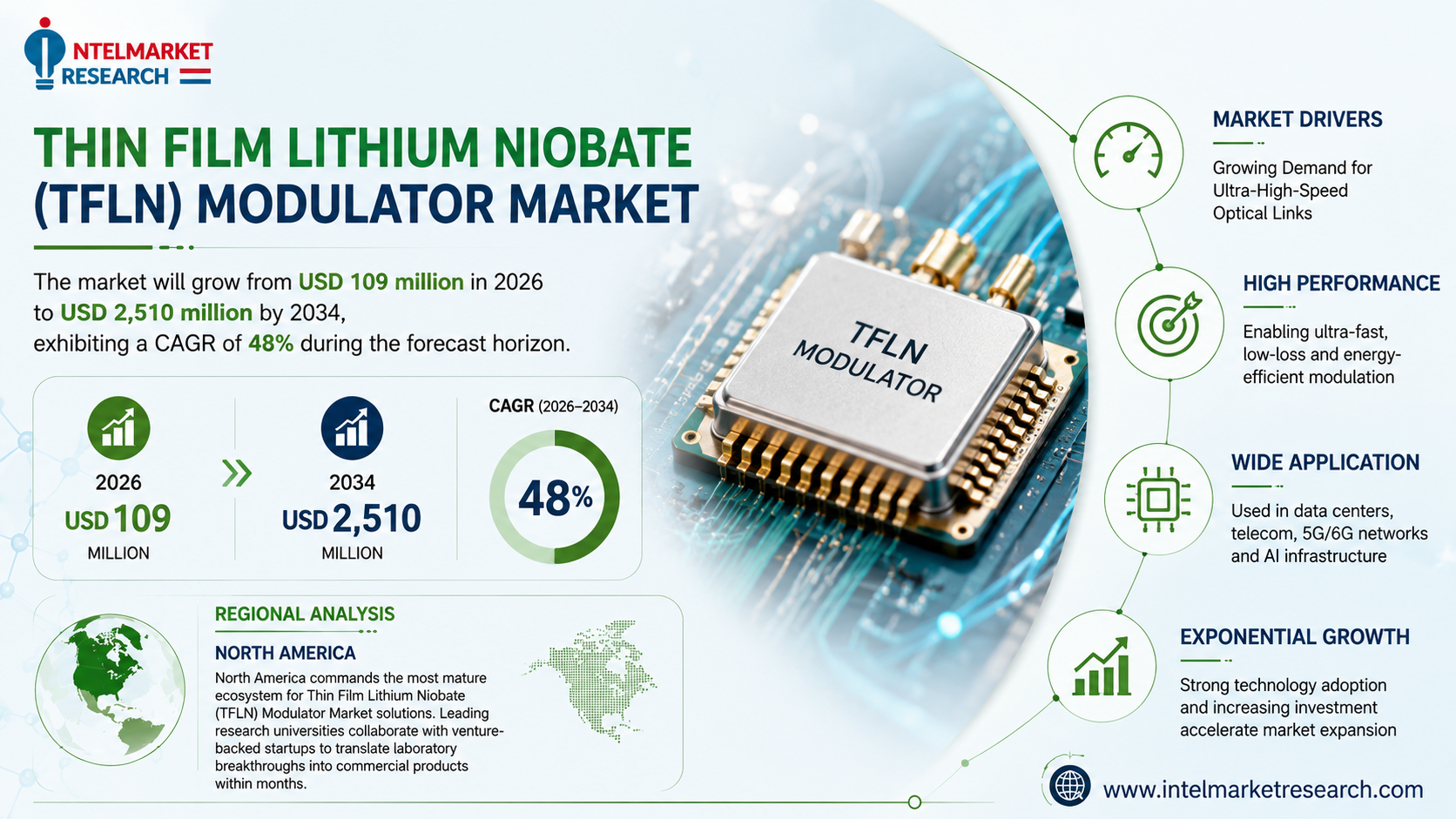

Thin Film Lithium Niobate Modulator Market to reach USD 2.51 billion by 2034 at 48% CAGR, driven by AI data centers and ultra-high-bandwidth optical links.
PUNE, MAHARASHTRA, INDIA, August 25, 2026 /EINPresswire.com/ — Thin Film Lithium Niobate (TFLN) Modulator Market is entering a more commercially consequential phase in 2026. The technology is no longer being evaluated only on laboratory bandwidth records. Buyers, system designers and photonic manufacturers are increasingly looking at a broader equation: bandwidth, drive voltage, insertion loss, packaging complexity, manufacturing scalability and compatibility with existing silicon photonics Infrastructure.
That shift is particularly important as AI infrastructure pushes optical interconnects toward higher data rates and tighter power budgets. Recent 2026 research and industry demonstrations are showing that TFLN platforms can address several of these requirements simultaneously, creating a stronger case for adoption across data centers, coherent communications, optical computing, sensing and emerging photonic systems.
𝐓𝐅𝐋𝐍 𝐆𝐚𝐢𝐧𝐬 𝐒𝐭𝐫𝐚𝐭𝐞𝐠𝐢𝐜 𝐈𝐦𝐩𝐨𝐫𝐭𝐚𝐧𝐜𝐞 𝐚𝐬 𝐈𝐧𝐭𝐞𝐠𝐫𝐚𝐭𝐞𝐝 𝐏𝐡𝐨𝐭𝐨𝐧𝐢𝐜𝐬 𝐄𝐧𝐭𝐞𝐫𝐬 𝐚 𝐍𝐞𝐰 𝐆𝐫𝐨𝐰𝐭𝐡 𝐏𝐡𝐚𝐬𝐞 𝐢𝐧 𝟐𝟎𝟐𝟔
The most important change in the market is the departure from the idea of the modulator as an isolated optical component.
⁍ Heterogeneous silicon photonics platform integrated with TFLN showed a path to manufacturing with current 8-inch and 12-inch wafer infrastructure at OFC 2026. The platform demonstrated electro-optic performance beyond 110 GHz and is well positioned for next generation pluggable optics, coherent transceivers and co-packaged optics.
This is commercially relevant because the next competitive advantage may not be the domain of the fastest standalone modulator. It could be the supplier who can integrate TFLN into a larger manufacturing ecosystem that doesn’t require customers to redesign their entire optical architecture.
𝐒𝐞𝐠𝐦𝐞𝐧𝐭 𝐈𝐧𝐭𝐞𝐥𝐥𝐢𝐠𝐞𝐧𝐜𝐞 𝐒𝐧𝐚𝐩𝐬𝐡𝐨𝐭
◘ 𝐓𝐲𝐩𝐞
• Thin Film Lithium Niobate Phase Modulator (High-Speed Performance Leader)
• Thin Film Lithium Niobate Intensity Modulator
𝗞𝗲𝘆 𝗶𝗻𝘀𝗶𝗴𝗵𝘁: Phase modulators are gaining the strongest market traction as coherent optical systems, 800G and emerging 1.6T architectures demand precise phase control, high bandwidth and low-voltage operation.
◘ 𝐀𝐩𝐩𝐥𝐢𝐜𝐚𝐭𝐢𝐨𝐧
• Optical Communication (Primary Revenue Generator)
• Fiber Optic Gyroscope
• Quantum Technologies
• Others
𝗞𝗲𝘆 𝗶𝗻𝘀𝗶𝗴𝗵𝘁: Optical communication remains the dominant application as hyperscale data centers and telecom networks transition toward higher-speed coherent links and increasingly power-efficient optical interconnects.
◘ 𝐄𝐧𝐝 𝐔𝐬𝐞𝐫
• Telecommunication Providers
• Data Center Operators (Fastest-Growing Demand Center)
• Research Institutions
𝗞𝗲𝘆 𝗶𝗻𝘀𝗶𝗴𝗵𝘁: Data center operators are driving adoption as AI workloads increase bandwidth requirements while intensifying pressure on optical power efficiency.
◘ 𝐈𝐧𝐭𝐞𝐠𝐫𝐚𝐭𝐢𝐨𝐧 𝐓𝐲𝐩𝐞
• Discrete Components
• Hybrid Integration (Preferred Commercial Architecture)
• Monolithic Integration
𝗞𝗲𝘆 𝗶𝗻𝘀𝗶𝗴𝗵𝘁: Hybrid integration leads as it combines TFLN’s high-speed performance with scalable silicon photonics and advanced packaging.
◘ 𝐓𝐞𝐜𝐡𝐧𝐨𝐥𝐨𝐠𝐲 𝐍𝐨𝐝𝐞
• First Generation TFLN
• Advanced TFLN Platforms (Current Innovation Leader)
• Next-Gen TFLN Architectures
𝗞𝗲𝘆 𝗶𝗻𝘀𝗶𝗴𝗵𝘁: Advanced TFLN platforms lead innovation through higher bandwidth, lower optical loss, improved electrode designs and enhanced integration.
🔸𝗚𝗮𝗶𝗻 𝗩𝗮𝗹𝘂𝗮𝗯𝗹𝗲 𝗜𝗻𝘀𝗶𝗴𝗵𝘁𝘀 𝗳𝗿𝗼𝗺 𝗢𝘂𝗿 𝗡𝗲𝘄𝗹𝘆 𝗨𝗽𝗱𝗮𝘁𝗲𝗱 𝗦𝗮𝗺𝗽𝗹𝗲 𝗥𝗲𝗽𝗼𝗿𝘁: https://www.intelmarketresearch.com/download-free-sample/21963/thin-film-lithium-niobate-modulator-market-market
𝐓𝐡𝐞 𝟏𝟎𝟎+ 𝐆𝐇𝐳 𝐓𝐡𝐫𝐞𝐬𝐡𝐨𝐥𝐝 𝐈𝐬 𝐁𝐞𝐜𝐨𝐦𝐢𝐧𝐠 𝐚 𝐂𝐨𝐦𝐦𝐞𝐫𝐜𝐢𝐚𝐥 𝐁𝐞𝐧𝐜𝐡𝐦𝐚𝐫𝐤
Bandwidth remains one of the strongest differentiators in the TFLN Modulator Market, but recent work suggests that the performance ceiling is continuing to move.
An IEEE Photonics Journal study published in January 2026 described a TFLN modulator design with a 1.25 V DC half-wave voltage and bandwidth above 100 GHz. The approach uses slow-wave-matched electrodes and optical waveguides to improve modulation efficiency while reducing the need for power-hungry RF amplification.
Other 2026 research has demonstrated 100 Gb/s OOK and 160 Gb/s PAM-4 transmission using a TFLN architecture with 67 GHz electro-optic roll-off.
For buyers, these advances change the question from “Can TFLN reach extremely high bandwidth?” to “Can that bandwidth be delivered at the voltage, power, cost and packaging conditions required for volume deployment?”
𝐂𝐨𝐦𝐩𝐞𝐭𝐢𝐭𝐢𝐯𝐞 𝐏𝐨𝐬𝐢𝐭𝐢𝐨𝐧𝐢𝐧𝐠 𝐈𝐬 𝐀𝐥𝐬𝐨 𝐒𝐩𝐥𝐢𝐭𝐭𝐢𝐧𝐠 𝐛𝐲 𝐀𝐩𝐩𝐥𝐢𝐜𝐚𝐭𝐢𝐨𝐧
The target market is increasingly segmented by application into three distinct competitive groups. High-Speed Communications Specialists prioritize bandwidth, linearity, low drive voltage, and coherent optical transmission to meet demanding data-transfer requirements.
Integrated Photonics Developers focus on hybrid solutions that combine thin-film lithium niobate (TFLN) with silicon photonics, silicon nitride, electronics, and advanced packaging for scalable, multifunctional photonic circuits. Meanwhile, Research and Emerging-Application Suppliers target niche domains such as quantum photonics, sensing, microwave photonics, and specialized optical systems, driving innovation in next-generation technologies.
𝐊𝐞𝐲 𝐂𝐨𝐦𝐩𝐚𝐧𝐢𝐞𝐬 𝐏𝐫𝐨𝐟𝐢𝐥𝐞𝐝;
🔸HyperLight Corporation
🔸Fujitsu Optical Components
🔸Advanced Fiber Resource (Zhuhai) Co., Ltd.
🔸Liobate Technologies
🔸Ori-Chip Photonics
🔸Lumentum Holdings
🔸NTT Electronics Corporation
🔸Thorlabs Quantum Electronics
🔸NeoPhotonics Corporation
🔸Lionix International
🔸Photonics Packaging Solutions
🔸Hobe Photonics
🔸Fabrinet Optical Technologies
🔸Coherent TFLN Solutions
🔸II-VI Photonics Division
𝐋𝐨𝐰 𝐕𝐨𝐥𝐭𝐚𝐠𝐞 𝐈𝐬 𝐄𝐦𝐞𝐫𝐠𝐢𝐧𝐠 𝐚𝐬 𝐭𝐡𝐞 𝐍𝐞𝐱𝐭 𝐁𝐚𝐭𝐭𝐥𝐞𝐠𝐫𝐨𝐮𝐧𝐝
High bandwidth alone does not solve the power problem inside modern optical networks. The electrical interface feeding the modulator can become a major contributor to system power and complexity.
This is why low-voltage operation is becoming a major development priority. Research published in 2026 has explored heterogeneous TFLN architectures capable of 200 Gb/s PAM4 transmission using a 1.8 V drive architecture and approximately 3 W power consumption while reducing reliance on power-intensive DSP functions.
⁍ At CLEO 2026, another TFLN modulator concept reported a Vπ·L of 0.64 V·cm with a theoretically predicted bandwidth above 65 GHz using dual-layer ITO/Au electrodes.
These developments point toward a market where voltage efficiency, RF simplicity and energy per transmitted bit could become as important as headline bandwidth.
𝐇𝐞𝐭𝐞𝐫𝐨𝐠𝐞𝐧𝐞𝐨𝐮𝐬 𝐈𝐧𝐭𝐞𝐠𝐫𝐚𝐭𝐢𝐨𝐧 𝐈𝐬 𝐑𝐞𝐝𝐞𝐟𝐢𝐧𝐢𝐧𝐠 𝐭𝐡𝐞 𝐒𝐮𝐩𝐩𝐥𝐲 𝐂𝐡𝐚𝐢𝐧
The commercial opportunity for TFLN is increasingly tied to integration with other photonic materials rather than replacing them.
At OFC 2026, researchers demonstrated a 200 mm wafer-scale heterogeneous platform integrating TFLN and hydrogen-free silicon nitride through die-to-wafer bonding. The platform achieved a reported 2.9 V·cm modulation efficiency.
Meanwhile, CLEO 2026 research demonstrated micro-transfer printing of a fully prefabricated TFLN modulator onto silicon photonic waveguides. The resulting 3 mm heterogeneous device achieved 1.4 dB on-chip insertion loss.
These developments could have major implications for the TFLN supply chain. Instead of relying exclusively on fully dedicated TFLN fabrication flows, manufacturers can explore bonding, transfer printing and heterogeneous integration models that leverage existing silicon photonics manufacturing assets.
𝐋𝐞𝐚𝐝𝐢𝐧𝐠 𝐆𝐞𝐨𝐠𝐫𝐚𝐩𝐡𝐢𝐜 𝐌𝐚𝐫𝐤𝐞𝐭𝐬 𝐃𝐫𝐢𝐯𝐢𝐧𝐠 𝐈𝐧𝐝𝐮𝐬𝐭𝐫𝐲 𝐄𝐱𝐩𝐚𝐧𝐬𝐢𝐨𝐧
🔹𝗡𝗼𝗿𝘁𝗵 𝗔𝗺𝗲𝗿𝗶𝗰𝗮: AI Infrastructure Creates the Strongest Commercial Pull
o North America is emerging as a major demand center for TFLN modulators, supported by hyperscale data centers, AI accelerator deployment and advanced optical networking.
o The region’s competitive advantage comes from the close relationship between photonic startups, semiconductor companies, cloud infrastructure providers and research institutions. U.S. initiatives aimed at strengthening domestic photonic material and component production are also increasing strategic interest in TFLN supply chains.
o The biggest opportunity lies in AI data center interconnects, co-packaged optics, high-speed transceivers and advanced computing architectures.
🔹𝗘𝘂𝗿𝗼𝗽𝗲: Photonics Engineering and Quantum Applications Strengthen the Market
o Europe has a different but complementary growth profile. Strong photonics research networks, semiconductor initiatives and industrial sensing capabilities are supporting TFLN development.
o Countries including Germany, the Netherlands, France and the U.K. have established expertise in integrated photonics and optical communications. TFLN is also gaining relevance in quantum technologies, precision measurement and advanced sensing.
o Europe’s opportunity is therefore not limited to telecom. Its competitive strength increasingly sits at the intersection of photonics, quantum technology, industrial sensing and advanced semiconductor integration.
🔹𝗔𝘀𝗶𝗮 𝗣𝗮𝗰𝗶𝗳𝗶𝗰: Manufacturing Scale Gives the Region a Structural Advantage
o Asia Pacific is expected to remain one of the most strategically important regions for TFLN modulators. Japan, China, South Korea and Taiwan combine strong telecommunications markets with extensive semiconductor, optical component and electronics manufacturing ecosystems.
o Japan brings established expertise in optical communications and photonic components, while China is rapidly expanding domestic capabilities across advanced optical devices and semiconductor technologies.
o The region’s biggest advantage is the potential to connect TFLN innovation with large-scale electronics and optical manufacturing, helping reduce production costs as commercial volumes increase.
🔹𝗟𝗮𝘁𝗶𝗻 𝗔𝗺𝗲𝗿𝗶𝗰𝗮: Telecom Modernization Creates a Gradual Opportunity
o Latin America’s TFLN market remains smaller than North America, Europe and Asia Pacific, but modernization of fiber infrastructure and increasing cloud adoption are creating longer-term opportunities.
o Demand is likely to emerge first through telecom operators, data center expansion and high-capacity backbone networks. Brazil and Mexico are particularly relevant because of their expanding digital infrastructure and connectivity requirements.
o Rather than immediate large-scale TFLN fabrication, the regional opportunity is more likely to develop through deployment of advanced optical networking equipment and imported high-performance photonic components.
🔹𝗠𝗶𝗱𝗱𝗹𝗲 𝗘𝗮𝘀𝘁 & 𝗔𝗳𝗿𝗶𝗰𝗮: Data Center Investment Opens a New Demand Channel
o The Middle East & Africa region is developing an emerging opportunity around hyperscale data centers, cloud infrastructure and digital transformation.
o Gulf economies are investing heavily in AI infrastructure and large-scale data center capacity, creating future demand for high-speed optical connectivity. TFLN could benefit as optical networks supporting AI clusters require higher bandwidth with tighter energy constraints.
o Africa presents a longer-term opportunity as fiber connectivity, cloud adoption and data center infrastructure continue to expand.
𝐀𝐈 𝐃𝐚𝐭𝐚 𝐂𝐞𝐧𝐭𝐞𝐫𝐬 𝐀𝐫𝐞 𝐂𝐫𝐞𝐚𝐭𝐢𝐧𝐠 𝐚 𝐍𝐞𝐰 𝐁𝐮𝐲𝐞𝐫 𝐏𝐫𝐨𝐟𝐢𝐥𝐞
AI infrastructure is changing who ultimately influences modulator technology decisions.
Traditionally, telecom operators, transceiver manufacturers and network equipment vendors have dominated the purchase of optical communications products and services. AI clusters are expanding the ecosystem to hyperscalers, data center operators, accelerator makers and advanced packaging companies.
The demand that grows is more fierce. Optical components need to support increasing bandwidth while minimizing power, latency and physical footprint. This transition is particularly relevant to the strong electro-optic response of TFLN, while heterogeneous integration provides a possible path to combine its optical performance with established silicon photonics manufacturing.
In the 2026 ECTC work on TFLN hybrid integration, a flip-chip assembly of a TFLN Mach-Zehnder modulator and a commercial open-collector driver was presented. The assembled device achieved a V$pi$L of 2.3 V$cdot$cm and more than 45 GHz of measured electro-optic bandwidth limited by the driver.
This is an important signal to the market. Packaging and electrical interfaces are becoming part of the TFLN competitive proposition, not downstream engineering problems.
𝐃𝐞𝐟𝐞𝐧𝐬𝐞 𝐚𝐧𝐝 𝐒𝐞𝐜𝐮𝐫𝐞 𝐂𝐨𝐦𝐦𝐮𝐧𝐢𝐜𝐚𝐭𝐢𝐨𝐧𝐬 𝐀𝐝𝐝 𝐚 𝐒𝐭𝐫𝐚𝐭𝐞𝐠𝐢𝐜 𝐃𝐞𝐦𝐚𝐧𝐝 𝐋𝐚𝐲𝐞𝐫
The opportunity is also expanding beyond commercial data transmission.
In February 2026, Raytheon announced an initiative with the U.S. Air Force Research Laboratory to develop domestic production capability for high-quality TFLN wafers. The company highlighted applications spanning high-speed secure communications, advanced sensing, AI and computing, data centers and telecommunications.
This development adds a supply-security dimension to the TFLN market. As demand for advanced photonic components increases, access to qualified wafers, fabrication expertise and domestic manufacturing capacity could become strategic considerations alongside cost and performance.
𝐍𝐞𝐰 𝐀𝐩𝐩𝐥𝐢𝐜𝐚𝐭𝐢𝐨𝐧 𝐅𝐫𝐨𝐧𝐭𝐢𝐞𝐫𝐬 𝐀𝐫𝐞 𝐌𝐨𝐯𝐢𝐧𝐠 𝐁𝐞𝐲𝐨𝐧𝐝 𝐓𝐞𝐥𝐞𝐜𝐨𝐦
The addressable opportunity for TFLN modulators is also broadening into applications that require precise, fast optical control. A 2026 ACS Photonics study highlighted TFLN’s strong electro-optic properties and broad transparency extending to approximately 400 nm, supporting potential applications in quantum technologies, optical clocks, metrology, biophotonics, spectroscopy and advanced sensing.
At CLEO 2026, researchers also demonstrated an ultra-compact TFLN electro-optic modulator with an approximately 1.3 × 0.09 mm² footprint and bandwidth above 40 GHz.
This creates a wider commercial landscape in which TFLN modulators could serve not only long-haul and data center communications but also compact optical systems, quantum photonics and precision instrumentation.
𝐊𝐞𝐲 𝐂𝐨𝐦𝐦𝐞𝐫𝐜𝐢𝐚𝐥 𝐃𝐞𝐯𝐞𝐥𝐨𝐩𝐦𝐞𝐧𝐭𝐬 𝐆𝐮𝐢𝐝𝐢𝐧𝐠 𝐒𝐦𝐚𝐫𝐭𝐞𝐫 𝐁𝐮𝐲𝐞𝐫 𝐃𝐞𝐜𝐢𝐬𝐢𝐨𝐧𝐬 𝐢𝐧 𝟐𝟎𝟐𝟔
➣ 𝗖𝗮𝗻 𝟭𝟬𝟬+ 𝗚𝗛𝘇 𝗽𝗲𝗿𝗳𝗼𝗿𝗺𝗮𝗻𝗰𝗲 𝗯𝗲𝗰𝗼𝗺𝗲 𝗺𝗮𝗻𝘂𝗳𝗮𝗰𝘁𝘂𝗿𝗮𝗯𝗹𝗲 𝗮𝘁 𝘃𝗼𝗹𝘂𝗺𝗲?
Laboratory performance is advancing rapidly, but high-volume production requires repeatable wafer processing, yield control and robust packaging.
➣ 𝗖𝗮𝗻 𝗧𝗙𝗟𝗡 𝗿𝗲𝗱𝘂𝗰𝗲 𝘀𝘆𝘀𝘁𝗲𝗺 𝗽𝗼𝘄𝗲𝗿 𝗿𝗮𝘁𝗵𝗲𝗿 𝘁𝗵𝗮𝗻 𝘀𝗶𝗺𝗽𝗹𝘆 𝗶𝗻𝗰𝗿𝗲𝗮𝘀𝗲 𝗯𝗮𝗻𝗱𝘄𝗶𝗱𝘁𝗵?
Low-voltage architectures, efficient RF interfaces and reduced DSP requirements will increasingly influence purchasing decisions.
➣ 𝗛𝗼𝘄 𝗾𝘂𝗶𝗰𝗸𝗹𝘆 𝗰𝗮𝗻 𝗵𝗲𝘁𝗲𝗿𝗼𝗴𝗲𝗻𝗲𝗼𝘂𝘀 𝗶𝗻𝘁𝗲𝗴𝗿𝗮𝘁𝗶𝗼𝗻 𝗺𝗮𝘁𝘂𝗿𝗲?
Integration with silicon, silicon nitride and CMOS-compatible electronics could determine how easily TFLN moves into mainstream optical platforms.
➣ 𝗪𝗶𝗹𝗹 𝗽𝗮𝗰𝗸𝗮𝗴𝗶𝗻𝗴 𝗯𝗲𝗰𝗼𝗺𝗲 𝗮 𝗽𝗿𝗶𝗺𝗮𝗿𝘆 𝗱𝗶𝗳𝗳𝗲𝗿𝗲𝗻𝘁𝗶𝗮𝘁𝗼𝗿?
Flip-chip bonding, wafer bonding and transfer printing suggest that the winning architecture may be determined as much by assembly economics as by the modulator itself.
➣ 𝗪𝗵𝗶𝗰𝗵 𝗮𝗽𝗽𝗹𝗶𝗰𝗮𝘁𝗶𝗼𝗻𝘀 𝘄𝗶𝗹𝗹 𝘀𝗰𝗮𝗹𝗲 𝗳𝗶𝗿𝘀𝘁?
AI data centers and high-speed optical interconnects currently represent a major commercial opportunity, while coherent communications, sensing, quantum photonics and defense applications could create additional demand pools.
𝐓𝐡𝐞 𝐌𝐚𝐫𝐤𝐞𝐭 𝐈𝐬 𝐌𝐨𝐯𝐢𝐧𝐠 𝐓𝐨𝐰𝐚𝐫𝐝 𝐏𝐞𝐫𝐟𝐨𝐫𝐦𝐚𝐧𝐜𝐞 𝐰𝐢𝐭𝐡 𝐚 𝐌𝐚𝐧𝐮𝐟𝐚𝐜𝐭𝐮𝐫𝐢𝐧𝐠 𝐒𝐭𝐫𝐚𝐭𝐞𝐠𝐲
The most important change in the TFLN Modulator Market in 2026 is not a single bandwidth record. It is the convergence of performance engineering and manufacturing strategy.
Research and industry demonstrations are simultaneously targeting higher bandwidth, lower voltage, reduced optical loss, smaller footprints and integration with established silicon photonics infrastructure. The appearance of 200 mm wafer-scale platforms, 8-inch and 12-inch manufacturing pathways, heterogeneous bonding and advanced packaging approaches indicates that the technology conversation is becoming increasingly commercial.
For optical component manufacturers, data center technology providers, foundries, telecom companies, investors and strategic buyers, the opportunity is therefore moving beyond simply tracking TFLN’s technical progress.
The more valuable question is which TFLN architectures can translate exceptional electro-optic performance into repeatable, low-power and scalable products.
As AI workloads continue to intensify optical bandwidth requirements, that distinction could determine which TFLN platforms remain research achievements and which become critical components of the next generation of global connectivity.
🔸𝐃𝐢𝐬𝐜𝐨𝐯𝐞𝐫 𝐅𝐫𝐞𝐬𝐡 𝐅𝐢𝐧𝐝𝐢𝐧𝐠𝐬 𝐟𝐫𝐨𝐦 𝐎𝐮𝐫 𝐑𝐞𝐜𝐞𝐧𝐭𝐥𝐲 𝐏𝐮𝐛𝐥𝐢𝐬𝐡𝐞𝐝 𝐑𝐞𝐩𝐨𝐫𝐭 𝐀𝐧𝐚𝐥𝐲𝐬𝐢𝐬: https://www.intelmarketresearch.com/thin-film-lithium-niobate-modulator-market-market-21963
𝐄𝐱𝐩𝐥𝐨𝐫𝐞 𝐑𝐞𝐥𝐞𝐯𝐚𝐧𝐭 𝐑𝐞𝐩𝐨𝐫𝐭𝐬:
💠𝐋𝐢𝐭𝐡𝐢𝐮𝐦 𝐍𝐢𝐨𝐛𝐚𝐭𝐞 𝐈𝐧𝐭𝐞𝐧𝐬𝐢𝐭𝐲 𝐌𝐨𝐝𝐮𝐥𝐚𝐭𝐨𝐫 𝐌𝐚𝐫𝐤𝐞𝐭: https://www.intelmarketresearch.com/lithium-niobate-intensity-modulator-market-38380
💠𝐒𝐢𝐥𝐢𝐜𝐨𝐧 𝐏𝐡𝐨𝐭𝐨𝐧𝐢𝐜𝐬 𝐓𝐞𝐬𝐭 𝐒𝐲𝐬𝐭𝐞𝐦 𝐌𝐚𝐫𝐤𝐞𝐭: https://www.intelmarketresearch.com/silicon-photonics-test-system-market-market-30857
💠𝐓𝐡𝐢𝐧-𝐅𝐢𝐥𝐦 𝐋𝐢𝐭𝐡𝐢𝐮𝐦 𝐍𝐢𝐨𝐛𝐚𝐭𝐞 (𝐓𝐅𝐋𝐍) 𝐏𝐡𝐨𝐭𝐨𝐧𝐢𝐜 𝐂𝐡𝐢𝐩 𝐅𝐨𝐮𝐧𝐝𝐫𝐲 𝐌𝐚𝐫𝐤𝐞𝐭: https://www.intelmarketresearch.com/thin-film-lithium-niobate-photonic-chip-foundry-market-59359
💠𝐎𝐩𝐭𝐢𝐜𝐚𝐥 𝐂𝐨𝐦𝐦𝐮𝐧𝐢𝐜𝐚𝐭𝐢𝐨𝐧 𝐈𝐂 𝐌𝐚𝐫𝐤𝐞𝐭: https://www.intelmarketresearch.com/optical-communication-ic-market-47232
💠𝐒𝐨𝐮𝐭𝐡 𝐊𝐨𝐫𝐞𝐚 𝐏𝐞𝐫𝐢𝐨𝐝𝐢𝐜𝐚𝐥𝐥𝐲 𝐏𝐨𝐥𝐞𝐝 𝐋𝐢𝐭𝐡𝐢𝐮𝐦 𝐍𝐢𝐨𝐛𝐚𝐭𝐞 𝐂𝐫𝐲𝐬𝐭𝐚𝐥 𝐌𝐚𝐫𝐤𝐞𝐭: https://www.24chemicalresearch.com/reports/279123/south-korea-periodically-poled-lithium-niobate-crystal-market
💠𝐋𝐢𝐭𝐡𝐢𝐮𝐦 𝐍𝐢𝐨𝐛𝐚𝐭𝐞 𝐏𝐡𝐚𝐬𝐞 𝐌𝐨𝐝𝐮𝐥𝐚𝐭𝐨𝐫 𝐌𝐚𝐫𝐤𝐞𝐭: https://semiconductorinsight.com/report/lithium-niobate-phase-modulator-market/
𝐀𝐛𝐨𝐮𝐭 𝐈𝐧𝐭𝐞𝐥 𝐌𝐚𝐫𝐤𝐞𝐭 𝐑𝐞𝐬𝐞𝐚𝐫𝐜𝐡
Intel Market Research is a leading provider of strategic intelligence, offering actionable insights in robotics, automation, and advanced manufacturing technologies. Our research capabilities include:
• Real-time competitive benchmarking
• Global technology innovation monitoring
• Country-specific regulatory and industry analysis
• Over 500+ technology and manufacturing reports annually
Trusted by Fortune 500 companies, our insights empower decision-makers to drive innovation with confidence.
🌐 𝐖𝐞𝐛𝐬𝐢𝐭𝐞: https://www.intelmarketresearch.com
🔗 𝐋𝐢𝐧𝐤𝐞𝐝𝐈𝐧: https://www.linkedin.com/company/intel-market-research
Rohan
IntelMarketResearch
+91 91691 64321
email us here
Visit us on social media:
LinkedIn
Facebook
YouTube
Legal Disclaimer:
EIN Presswire provides this news content “as is” without warranty of any kind. We do not accept any responsibility or liability
for the accuracy, content, images, videos, licenses, completeness, legality, or reliability of the information contained in this
article. If you have any complaints or copyright issues related to this article, kindly contact the author above.

Media gallery