Investors Adopt Dual-Track Modeling for Short-Term Rental Strategies
Financial analysts increasingly build side-by-side projections comparing short-term and long-term lease economics The
Press Release Disclaimer: This is a press release distributed through the XPR Media network. It has not been independently verified by our newsroom.

Financial analysts increasingly build side-by-side projections comparing short-term and long-term lease economics
ZURICH, SWITZERLAND, August 25, 2026 /EINPresswire.com/ — Property investors are restructuring their analytical workflows to compare short-term rental cash flows against long-term lease scenarios within unified financial models. The practice reflects a market environment where regulatory frameworks for short-term rentals have become significant variables in investment underwriting rather than static background assumptions.
The shift marks a departure from the siloed analysis that characterized the sector during the pandemic-era expansion. Investors who previously evaluated short-term rental opportunities as standalone assets are now modeling them as strategic alternatives within broader portfolios, weighing the revenue premiums of hospitality-style operations against the occupancy stability of conventional leases. The analytical exercise has become central to acquisition decisions and refinancing discussions.
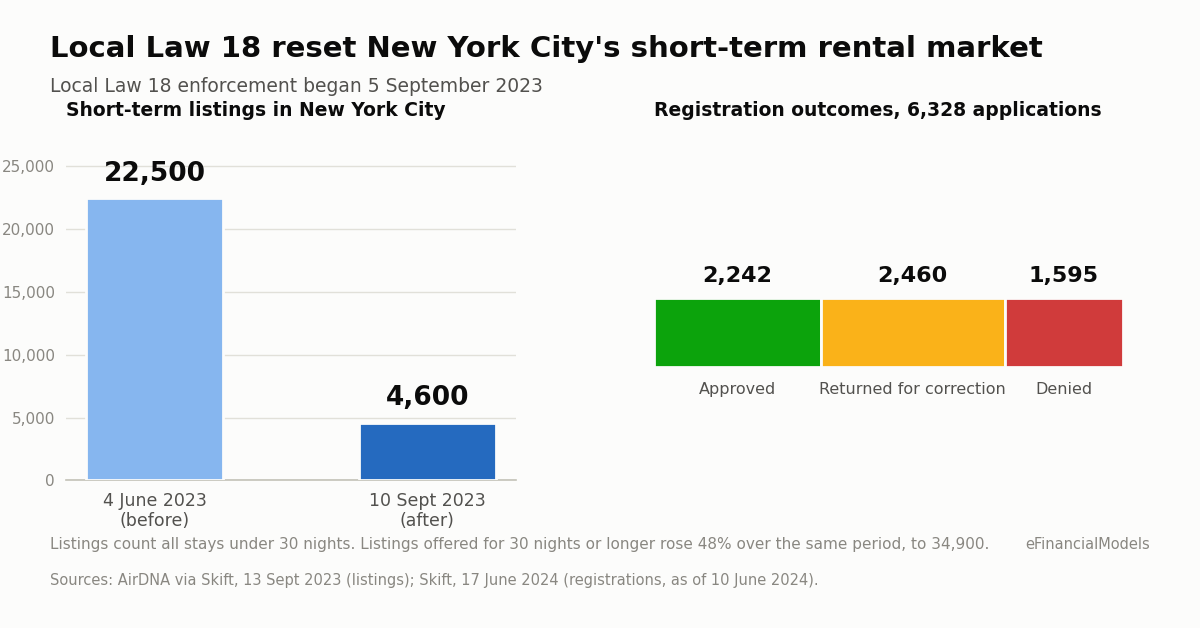
The regulatory risk is not hypothetical. New York City’s Local Law 18 registration regime cut short-term listings in the city from roughly 22,500 in early June 2023 to about 4,600 by September 10, 2023, according to AirDNA figures reported by Skift, while listings offered for 30 nights or longer rose 48 percent over the same period. Of the 6,328 host registration applications the city had received by June 10, 2024, 2,242 were approved and 1,595 denied, with the remainder returned for correction.
Financial analysts note that the complexity of short-term rental regulations now requires explicit scenario planning rather than simple sensitivity adjustments. Licensing requirements, occupancy limits, and compliance documentation vary across jurisdictions and frequently change, making multi-year cash flow projections dependent on assumptions about regulatory risk rather than market demand alone. Investors increasingly seek models that can toggle between operational scenarios to test how regulatory shifts affect net operating income, cap rates, and debt service coverage ratios.
The trend has elevated demand for financial templates that accommodate dual-track analysis. Analysts report spending more time on probability-weighted outcomes and stress-testing portfolios against scenarios where short-term rental permissions are restricted or revoked entirely. The modeling emphasis has moved from maximizing revenue per available night to understanding the economic trade-offs between different lease structures under varying regulatory regimes.
“The conversation has shifted from asking which strategy generates higher returns to asking which strategy the investor can sustain if the regulatory landscape changes,” said a spokesperson for eFinancialModels. “Investors now want to see both scenarios in the same workbook, with clear triggers for when to pivot from one strategy to the other.”
The platform offers more than 3,100+ templates for investors navigating these analytical demands. The marketplace serves 100k+ finance professionals worldwide. The real estate category includes specialized models designed for rental property analysis, with templates that support both short-term and long-term lease projections. These tools allow investors to input jurisdiction-specific assumptions and compare returns across operational strategies.
Industry professionals emphasize that the modeling discipline serves risk management purposes beyond immediate investment decisions. Lenders increasingly request scenario analyses that demonstrate how borrowers would service debt if short-term rental revenues declined due to regulatory action. Institutional investors use similar frameworks to evaluate portfolio concentration risk across markets with varying regulatory postures.
The evolution represents a maturation of the short-term rental investment sector. Where early entrants focused primarily on revenue optimization, current market participants treat regulatory compliance and operational flexibility as core underwriting variables. Financial modeling has become the primary tool for integrating these considerations into quantitative decision-making.
Investors seeking to evaluate rental property opportunities can explore specialized financial model templates at eFinancialModels.
Communications Team eFinancialModels
eFinancialModels
info@efinancialmodels.com
Visit us on social media:
LinkedIn
Bluesky
Instagram
Facebook
YouTube
TikTok
X
Legal Disclaimer:
EIN Presswire provides this news content “as is” without warranty of any kind. We do not accept any responsibility or liability
for the accuracy, content, images, videos, licenses, completeness, legality, or reliability of the information contained in this
article. If you have any complaints or copyright issues related to this article, kindly contact the author above.

Media gallery