Lorecivivint for Knee OA: UK MHRA Accepts Biosplice Application
UK's MHRA accepts Biosplice's application for lorecivivint (LOR), a potential first disease-modifying treatment for knee osteoarthritis. Regulatory assessment begins.
Press Release Disclaimer: This is a press release distributed through the XPR Media network. It has not been independently verified by our newsroom.
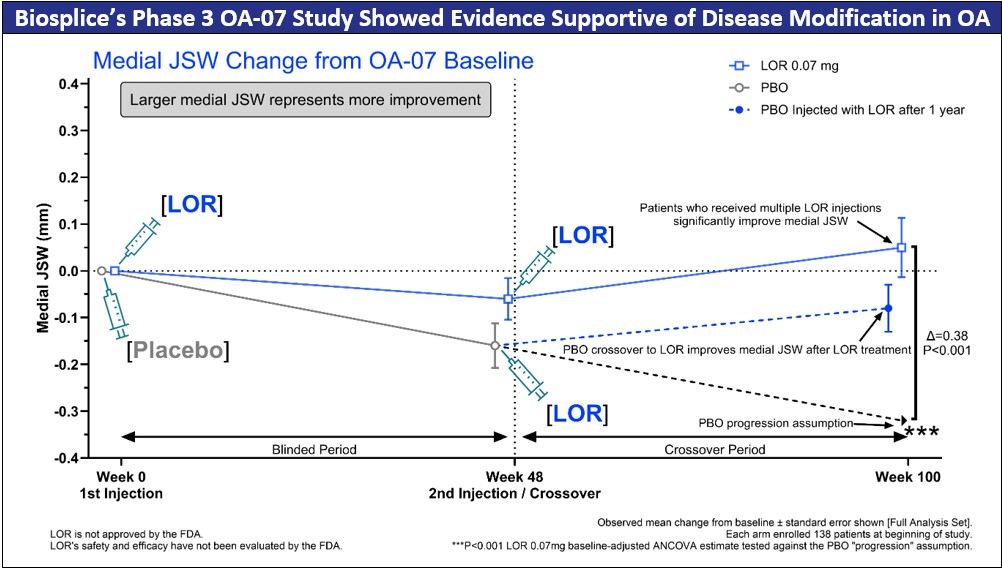

SAN DIEGO, Sept. 08, 2026 (GLOBE NEWSWIRE) — Biosplice Therapeutics, Inc. (“Biosplice”), a late-stage biopharmaceutical company developing lorecivivint (“LOR”), a first-in-class small-molecule inhibitor of CLK/DYRK kinases, for the treatment of knee osteoarthritis (“OA”), announced today that the United Kingdom’s Medicines and Healthcare products Regulatory Agency (“MHRA”) has determined Biosplice’s application for approval of LOR to be complete and valid. Acceptance of the application starts the MHRA’s formal review timetable and moves LOR into regulatory assessment in the United Kingdom. LOR is a small-molecule suspension intended to be injected 1-2 times per year into the knee joint. LOR, evaluated in eleven clinical trials, significantly improved joint structure, pain and function in patients, with a well-established safety profile across all trials. Disease modification was demonstrated primarily in Biosplice’s Phase 3 OA-07 trial, which showed that LOR improved medial joint space width (JSW) on imaging over multiple years—JSW is the usual standard by which structural disease progression is clinically measured. These results support LOR’s potential to be the first disease-modifying therapy for OA, a milestone long sought by patients, physicians and researchers. Taken together, the clinical data suggest a highly positive benefit-to-risk profile.
In its acknowledgement notification, the MHRA confirmed that preliminary checks of the LOR dossier have been completed, that the submission is considered valid, and that it is now ready for the start of assessment. Biosplice intends to submit an application for LOR to the European Medicines Agency (“EMA”) later this month.
Erich Horsley, CEO of Biosplice, commented, “After more than a decade of clinical development and eleven clinical trials, lorecivivint is now formally under assessment in the United Kingdom. As many knee OA patients are aware, the patient journey for someone diagnosed with knee OA is currently painful and disheartening. Patients have gone decades without a meaningful new treatment option, and this assessment could be an important step towards dramatically improving the quality and duration of millions of patient lives.”
Louis Tharp, Executive Director of the patient support group Global Healthy Living Foundation / CreakyJoints, added, “We hear constantly from osteoarthritis patients who await safe, innovative and potentially disease-modifying medicines to treat OA. The UK’s review of LOR for approval brings hope to millions of long-suffering patients.” More information on LOR can be found at https://creakyjoints.org/oaadvocacy.
OA-07 demonstrated joint structure benefits rarely observed in OA research: patients treated with LOR in the OA-07 study maintained and ultimately improved their medial JSW, as measured by X-ray at two years following annual injections. Placebo patients whose medial JSW decreased during the first year of OA-07, once crossed over to active treatment with LOR, also showed increases in medial JSW following cross-over.
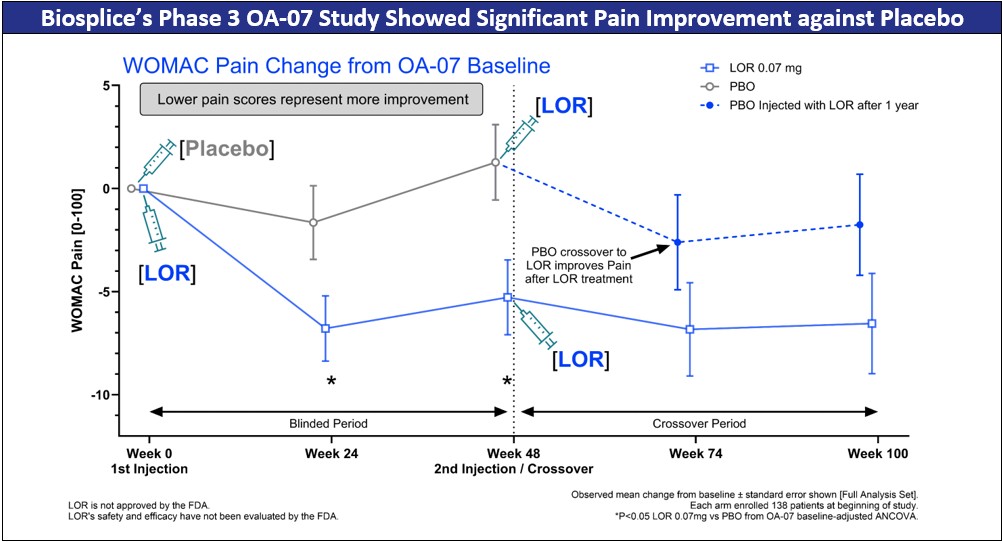
Beyond structural improvement, the Phase 3 OA-07 study showed patients dosed with LOR significantly improved their pain scores at 6 months and both pain and function at 12 months, compared to placebo. Similar improvements in structure, pain and function were also seen in Phase 2 trials, confirming the benefit of LOR in OA patients. The figure below shows pain scores in the OA-07 study. Patient-reported pain outcomes have historically been the main approval endpoint for OA with regulatory authorities.
Biosplice has been developing LOR for over a decade and initially synthesized and identified the novel compound in 2011. LOR is a small-molecule drug that selectively inhibits two kinases, DYRK1A and CLK2. DYRK1A is an inflammatory kinase, the inhibition of which results in significant reductions in multiple inflammatory cytokines and catabolic enzymes that break down hyaline cartilage. CLK2 alters local Wnt pathway signaling, which is believed to promote chondrocyte formation and the protection of hyaline cartilage.
Any application for the approval of a new medicine in OA must be supported by data demonstrating that it is safe. Throughout the decade-long clinical development program, LOR’s safety profile has been consistent with and similar to that of placebo. LOR’s safety is enhanced by the fact that, when injected into the knee joint, the drug has no detectable systemic exposure throughout the body.
About Osteoarthritis
Osteoarthritis (OA), the most common form of arthritis, is a serious chronic disease that affects an estimated 50 million U.S. adults and over 500 million adults globally1. OA is the most prevalent joint disease and a leading source of chronic pain and disability in the United States. OA may affect the knees, hips, shoulders, hands, spine, or great toes; current estimates indicate that about 25 million U.S. adults, 1 in 10, have knee OA alone1. Although OA is often considered a disease of old age, approximately half of symptomatic knee OA diagnoses occur by age 55.2
Those who live with OA experience pain, stiffness, and swelling, which limit their function and mobility, often impacting their daily lives. Functional limitations are present in about 80% of people with OA, and 25% are unable to perform major activities of daily living3. Mortality is higher in patients with knee and hip OA largely due to cardiovascular disease, with a higher risk of death associated with severity of walking disability4. Given both the increased morbidity and mortality, the US FDA has accepted knee OA as a “serious condition.”
About Lorecivivint (LOR)
Lorecivivint is a small-molecule suspension drug intended to be injected into the intra-articular knee joint space for the treatment of OA. LOR has been tested as a once-per-year or every-six-month injection in Biosplice’s development program. LOR’s mechanism of action is based on selective and potent inhibition of DYRK1A and CLK2 kinases. DYRK1A inhibition has been shown to reduce inflammation and catabolic enzymes, and inhibition of CLK2 is believed to provide cartilage protective and regenerative properties. The extensive clinical development program for LOR has provided evidence of statistically and clinically significant improvement in pain, function and medial JSW, with a well-established safety profile. LOR is an investigational medicine and has not been approved by the MHRA, the FDA or any other regulatory authority.
About Biosplice
Biosplice is a late-stage biopharmaceutical company focused on lorecivivint, a first-in-class small-molecule inhibitor of CLK/DYRK kinases being developed as a potentially disease-modifying treatment for knee osteoarthritis. Biosplice’s work is grounded in novel biology linking CLK/DYRK kinases to the therapeutic regulation of alternative splicing. Lorecivivint has been submitted for approval in the United States and is under assessment in the United Kingdom. Biosplice also holds a majority interest in TenaRx, which is developing programs in oncology, diabetes and neurology. Learn more at https://www.biosplice.com.
Forward-Looking Statements
This press release contains forward-looking statements, including statements regarding the timing of Biosplice’s anticipated regulatory submissions, including its intended submission to the EMA, the MHRA’s assessment of Biosplice’s marketing authorisation application for lorecivivint, the expected timing and outcome of that assessment, the review and potential approval of lorecivivint by the MHRA, the FDA or any other regulatory authority, and the therapeutic potential of lorecivivint. Forward-looking statements are based on current expectations and assumptions and are subject to risks and uncertainties that could cause actual results to differ materially. These risks and uncertainties include, among others, uncertainties inherent in the regulatory review process, including the possibility that a regulatory authority may request additional information, may extend or suspend its review timetable, or may decline to grant approval, and other risks associated with drug development and commercialization. Statements regarding statutory review timetables reflect published regulatory guidance and are not assurances as to the timing of any regulatory decision. Biosplice undertakes no obligation to update or revise any forward-looking statements contained herein, whether as a result of new information, future events, or otherwise.
________________________
1 IFHMaE. 2021. ‘GBDx Results Tool,’ IHME, University of Washington, Accessed January 7, 2021. http://ghdx.healthdata.org/gbd-results-tool
2 Losina E, et al. Arthritis Care Res (Hoboken). 2013.
3 Neogi T. Osteoarthritis Cartilage. 2013.
4 Osteoarthritis Research Society (OARSI). Osteoarthritis: A Serious Disease. Published December 1, 2016. Accessed June 25, 2024. https://oarsi.org/sites/oarsi/files/docs/2016/oarsi_white_paper_oa_serious_disease_121416_1.pdf
Photos accompanying this announcement are available at:
https://www.globenewswire.com/NewsRoom/AttachmentNg/ea227fdc-09b3-44c3-9a48-c5872e7859a0
https://www.globenewswire.com/NewsRoom/AttachmentNg/397bc6e2-6c62-4226-92f4-979a97f5e334

Corporate Contact:
Phil Wilson, CFO
Biosplice Therapeutics, Inc.
phil.wilson@biosplice.com